
Markerless Motion Capture Arrives in Unreal Engine 5.8
Epic's Meshcapade acquisition is already showing up in MetaHuman Animator, with full-body capture from ordinary video.
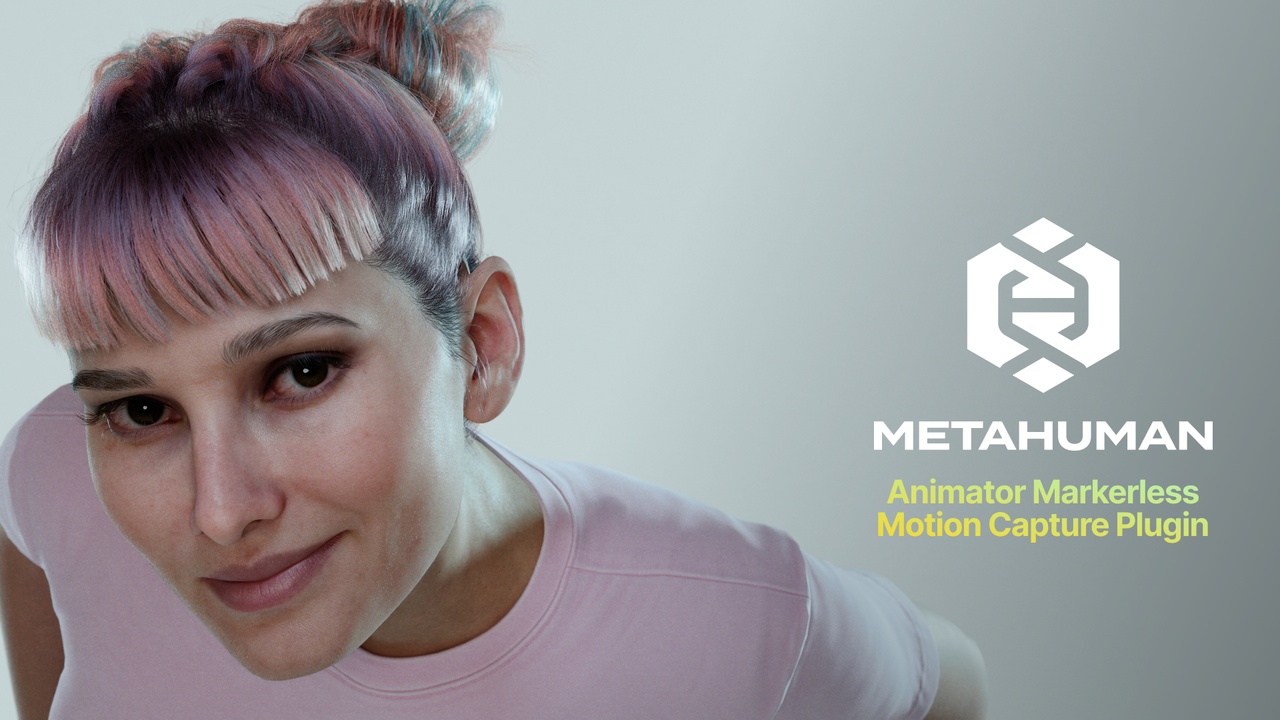
At this week’s State of Unreal, Epic released Unreal Engine 5.8 and introduced an experimental MetaHuman Animator Markerless Motion Capture plugin. It can take standard video from a phone, webcam, or more elaborate camera setup and turn it into full-body animation, including hands, directly inside the MetaHuman Animator workflow.
No markers, no suit, and no dedicated volume. More importantly for an Unreal project, there is no separate web service and no awkward export format sitting between the solve and the character. The footage is processed locally, the output is a normal animation sequence, and it can drive a MetaHuman directly or be retargeted to another character.
I have used Meshcapade before, so this announcement felt both new and familiar. The underlying approach—recovering a useful 3D human performance from ordinary video—is exactly the problem Meshcapade has been working on for years. Epic acquired the company in February, bringing its team into Epic’s AI Research group to contribute to Unreal Engine and MetaHuman.
UE 5.8 is the first very visible result of that combination.
From a clever service to part of the pipeline
Meshcapade’s technology grew out of the SMPL family of human-body models. SMPL represents body shape and pose in a compact, structured way, which has made it enormously useful across research and production. Meshcapade built practical tools around that foundation, including markerless capture from monocular video.
When I used Meshcapade, the appeal was obvious: the input was video rather than a specialized capture system. That lowers the cost of trying an idea. You can record a performance quickly, see whether the motion is useful, and decide how much further investment the shot deserves.
The friction was that it still lived outside the engine. Footage had to leave one environment, be processed elsewhere, come back as animation data, and then be mapped into the project’s character setup. None of those steps is impossible, but each one creates another place for scale, orientation, skeleton, naming, versioning, or automation to go wrong.
Putting the solve inside MetaHuman Animator changes the character of the tool. It is no longer merely a fast way to obtain a motion file. It can become part of the same capture, review, batch-processing, Sequencer, and retargeting workflow the team already uses.
That integration may be more valuable than any individual improvement to the solve.
Face and body from the same source
MetaHuman Animator already had a strong facial-capture pipeline. In 5.8, the same performance asset can process body motion, or face and body together, from a single camera. Epic also supports a two-camera path where dedicated face footage and a separate body view are combined in a level sequence.
The single-camera version is the attention-grabber because the setup is so small. Put a person in frame, record the take, and solve it locally. For previs, prototypes, secondary characters, and rapid iteration, that is a substantial expansion of what a small team can capture.
The two-camera path is probably just as interesting for higher-end work. It acknowledges that a convenient capture and an ideal facial close-up do not always want the same camera position. Teams can choose the amount of hardware and ceremony that fits the shot instead of committing the entire production to one capture tier.
Because all MetaHumans share a common skeleton, Epic can also solve against a stand-in before the final character exists. That is the sort of detail that turns an impressive demo into useful production tooling: performance work no longer has to wait for every part of the character pipeline to finish.
Capture is not the same as finished animation
Markerless motion capture is easy to oversell. A single camera cannot observe everything. Self-occlusion, floor contact, fast motion, loose clothing, props, interactions between performers, and fingers hidden from view all create ambiguity. A model can infer a plausible result, but plausible is not always physically or dramatically correct.
The new plugin is explicitly marked experimental and currently limited to Windows. I would expect the normal production questions to remain:
- How stable are the feet during planted motion?
- What happens when hands cross the body or interact with an object?
- How well does the solve preserve weight, balance, and subtle timing?
- How much cleanup is required after retargeting to characters with different proportions?
- Can the same setup produce consistent results across hundreds of takes?
Those details will determine where the feature is ready to replace another capture method and where it is best used as reference or a first pass.
But the comparison should not always be against a perfect optical stage. Often the real alternatives are hand-keying a rough performance, searching a motion library for something vaguely appropriate, or not animating the idea at all. Against those options, accessible markerless capture can be transformative well before it is flawless.
A better iteration loop
The most exciting use may be iteration rather than final capture.
A designer can act out a traversal idea and have it on a character quickly. A cinematic team can block a scene before arranging a full shoot. An animator can use their own performance as three-dimensional reference. A small studio can capture secondary motion that would never justify a stage. Even on productions with conventional motion capture, the tool can help answer questions before the expensive part begins.
This is also a machine-learning feature that fits naturally into an artist’s workflow. The model is not asked to invent a performance from a prompt. It translates a performance the user supplied into a form the engine can use. The artist still provides the timing, intent, and physical idea; the system reduces the technical cost of getting that idea onto a character.
That division of labour is compelling. It preserves direction while making capture much more available.
What the acquisition looks like from here
Epic’s acquisition of Meshcapade made sense on paper: one company had deep expertise in learned human-body models and markerless capture, while the other had MetaHuman, Unreal Engine, and a very large audience trying to animate digital people.
Only a few months later, that connection is visible in an Unreal workflow anyone can download. The original Meshcapade platforms have shut down, so there is a real tradeoff for people who used the standalone service. The technology now has a much larger home, but it is also tied more directly to Epic’s ecosystem.
For me, UE 5.8’s plugin is a promising version of that future. The processing is local. The output is ordinary animation data. The result can be retargeted beyond MetaHumans. Those choices make the feature feel like production infrastructure rather than a sealed demonstration.
It is experimental, and I would not plan a shoot around it without testing the exact movements, cameras, and characters involved. But the direction is clear. High-quality motion capture is becoming less about access to a particular room full of hardware and more about what we can recover from cameras that are already everywhere.
Having tried the earlier Meshcapade workflow, I am especially interested to see what happens when that technology is allowed to become a native part of Unreal rather than a stop along the way.